


Volatility Pushes Indian Investors Toward Multi-Asset Funds

By Vishal Raja Durai V
Introduction
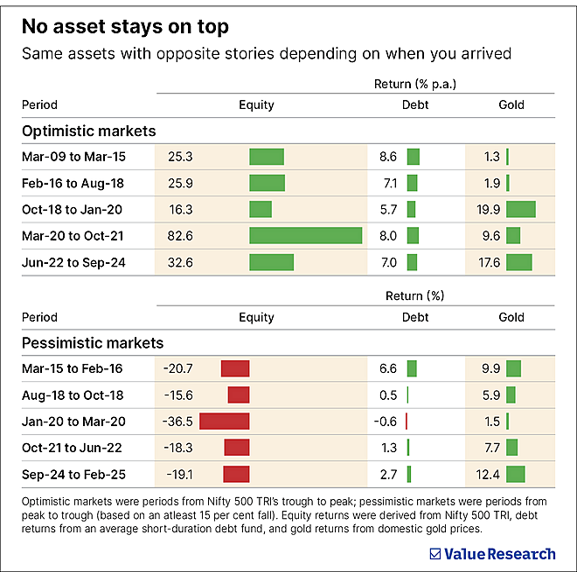
Well, no investor today can say with confidence which asset class will do better next. Equities have been volatile during the last one year with the Sensex down by almost 4 per cent, while short-term debt had clocked close to 5.38 per cent last year. After a sharp rally earlier, gold and silver have corrected, and with every asset class comes its own bugbear, choosing where to put fresh money becomes a difficult choice.But the uncertainty has resurrected an old idea: diversification, which is spreading your money around a few asset classes. An investment that offers this idea in one package, the multi-asset allocation fund, is drawing more interest from Indian investors.
Source: Value Research
What Are Multi-Asset Allocation Funds?
A multi-asset allocation fund is a mutual fund that invests in equities, debt, gold and silver commodities as well as cash through a single portfolio. It is not aimed at investing in the 'top-performer' of the year. Rather it aims to reduce or eliminate reliance on a particular asset class and to maintain a balanced portfolio in different market cycles.It is also for this reason that the logic makes sense. I want to make sure you understand that everything is affected by other things. Equity is driven by earnings and valuation of companies, debt is driven by interest rates and the credit cycle, whereas gold responds to the dollar, real interest rates and uncertainty. Silver also responds to demand, especially from industry.
Sanjay Bembalkar, Union Mutual Fund, adds that while value for gold and silver and also for equity and debt is driven largely by cash flows, for gold and silver demand and supply plays a major role. An investor can thereby have a better risk balance in the portfolio by combining the two.

Source: RR Finance
Investors Are Having Their Say with Their Cash
That gives an indication of how eager investors have been for the category. Inflows to multi-asset allocation funds stood at ₹3,753 crore in July, after 59 consecutive months of positive flows, data from the Association of Mutual Funds in India (AMFI) showed. Among hybrid funds, they have been the fastest-growing category, with assets rising 58.3 per cent in a year and a huge 501.8 per cent over three years.The returns were worth it. According to Value Research, the category has returned 12.91% on average over a year, 15.48% over three years and 13.04% over five years. All this is quite astonishing, considering the category was more meant to buffer shocks rather than generate spectacular returns.

Source: WhiteOak Capital Mutual Fund, Market Perspective
Which is more important: Asset Allocation or Selection?
There is general consensus that allocation has gained significance but experts vary on the extent to which it should entirely replace selection. Gurmeet Singh Chawla, MD at Master Portfolio Services, reckons that "with the current unease around interest rates, geopolitical risk and market volatility, the determination of the percentage of each instrument might play a bigger role in a portfolio performance than in discovering the next multibagger stock".Harshad Borawake of Mirae Asset Mutual Fund hasn’t been sold on the idea. In his opinion, the two are a different ballgame: allocation is about how much risk is to be kept in each asset class; selection is about how much can be outperformed in the desired class. Bembalkar says that since it's hard to tell the next best asset class, multi-asset investing introduces discipline and takes away the need to constantly make tactical calls.Simply put, allocation is the base, and selection is the top. Nothing is better than either of the two.
What Factors Should Retail Investors Consider for Allocation?
There is no one size fits all. The "mix" you choose is based on your age, risk appetite, goal time horizon, your goals and liquidity needs. Mix should be thought of at the portfolio level as a whole and not at the asset class level. Chawla would recommend a higher percentage of equity holdings for the younger investor with a longer-term horizon and a higher debt for the investor near their goal horizon. He’s comfortable with a 10% to 20% exposure to gold as insurance while limiting the others. Bembalkar mentions that the same can't be recommended for all as one has to take the existing portfolio and liquidity needs into account.
When and How Should Investors Rebalance?
Portfolio monitoring Investment managers suggest investors should review their portfolios at six monthly intervals, or more often if there have been any major changes to income, investment goals or risk profile. Don’t rebalance your allocations just because the market becomes volatile."It should be a material deviation in terms of the allocation, not driven by market movements, since it can lead to an increase in transaction costs," said Borawake. "As Bembalkar suggests, the purpose of a review is to assess the ongoing correspondence of the portfolio to the investor's objective and risk profile. For multi-asset funds, this is decided by the fund manager on behalf of the investor.
Is a Multi-Asset Fund Suitable for All?
This money is more appropriate for retail investors who don't have the expertise or money to piece together individual portfolios of different asset classes. Said Chawla, but they may not outperform pure equity funds in a bull run. Their real value is in their risk management and the smoothness of the investing experience.Borawake also reminds investors to be aware of an ETF's equity limit, commodity exposure, and risk profile in which they are investing because that is the one factor they have control over, while the potential rebalancing, however, shifts to a team.
Conclusion
Don’t put all your eggs in one basket A multi-asset approach can help protect investors from chaos in any one asset class in a volatile world. The goal is not to avoid risk altogether, but instead, to develop a more conservative and resilient portfolio that can endure all the fluctuations of every market cycle. Multi-asset funds are not suitable for all investors.


Comments