


Valuations and thin liquidity cloud Small-Cap prospects

By Lekhan
Small-Cap Stocks face prolonged headwinds due to the valuation challenge. The Indian small cap stock segment has hit a rough patch in 2025, and according to market observers, the troubles are far from over. After two stellar years that saw these stocks surge nearly 93%, the segment now confronts a stark reality, prices rose much faster than underlying business performance, and the bill for that mismatch has come due.For investors who supported the small cap wave through 2023 and 2024, this year has delivered them with a bad blow. The Nifty Small Cap Index has declined 9% in 2025, marking its first lag behind large and mid cap benchmarks in three years.

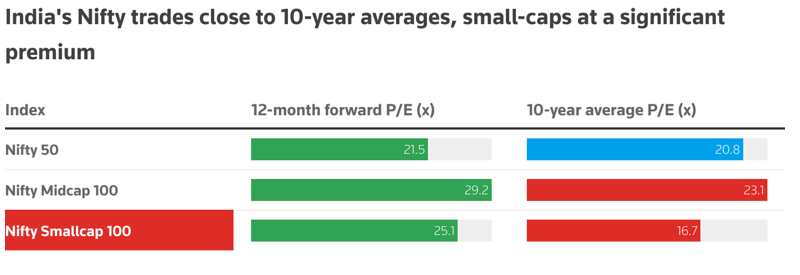
The impact reaches deeper than the headline numbers given. Nearly 73% of stocks in the Nifty 500 remain more than 10% below their record highs. For small caps specifically, the pain is more acute. The index is 13% below compared to how much it once achieved in 2024, and nearly half the equities are still selling more than 50% below their all time highs. These are not minor corrections; they represent substantial fall in wealth for anyone who bought near the top or failed to take a decision for profits when times were good. At its root, the small cap struggle boils down to a simple but terrible truth. Valuations got way ahead of reality. During the rally years, investors paid premium prices based on optimism about future earnings growth that simply has not materialized. The numbers tell the story starkly. While the Nifty 50 trades near its 10 year average price to earnings ratio, small caps command forward multiples of 25.1 times expected earnings, well above the long term average of 16.7 times. Mid caps face a similar issue, trading at 29.2 times versus a historical norm of 23.1 times. Harsha Upadhyaya, chief investment officer at Kotak Mahindra Asset Management Company, framed the dilemma bluntly. "Either valuations must correct further, meaning more pain for small caps, or earnings in the second half must rebound so sharply that they start outperforming mid and large caps. Neither looks likely". That assessment captures the uncomfortable position the segment finds itself in: stuck between expensive valuations and moderate earnings growth with no quick resolution in sight. Valuations have become "priced for perfection" as the small cap index gained 93% in 2023 and 2024. Investors were still hoping it would perform strong, and for a while, the momentum did seem self sustaining.
Companies that saw their stock prices climb based on growth projections rather than current results were disappointment with the earnings.These stocks saw big corrections as investors evaluated their positions. Beyond valuation, small caps suffer structural hurdles that magnify their volatility. Unlike large cap stocks that trade with deep, steady volumes, many small cap shares trade with less volume. This creates a difficult dynamic, when selling pressure emerges, prices can fall sharply because there are not enough buyers to absorb the supply. Conversely, modest buying interest can trigger sudden rallies that seem disconnected from fundamental business changes. The potential for outsized profits comes accompanied with the risk of quick drawdowns, and discriminating between genuine opportunities and inflated equities needs both analytical expertise and emotional discipline. The current environment presents multiple headwinds for small caps. A risk averse global environment and a crowded initial public offering pipeline have further redirected cash toward safer large caps. This suggests an extended period of either sideways trading or additional price weakness as the market slowly digests the excesses built up during the rally years.

When uncertainty rises, investors naturally migrate toward the stability and liquidity of larger companies, leaving smaller firms with lack of capital.This quest for quality has created a split market where gains are concentrated among the biggest enterprises while the broader market struggles. That dynamic appears likely to persist as long as valuation concerns and earnings uncertainty continue weighing on investment or sentiment toward smaller firms.Looking forward, analysts see limited catalysts for a quick recovery. The valuation gap remains wild and there is little evidence that earnings will accelerate dramatically enough to justify current prices. This suggests an extended period of either sideways trading or additional price weakness as the market slowly digests the excesses built up during the rally years.For investors still holding small cap positions, the choices are uncomfortable. Selling now locks in losses, but holding requires faith that either valuations will eventually appear reasonable relative to future earnings or that earnings will catch up to current prices. Neither path offers much comfort in the near term.

As 2025 comes to an end, small cap investors will confront a much different reality than what they enjoyed in previous years. The segment faces stretched valuations, moderate earnings, and thin liquidity are likely to persist into 2026. Quick fixes appear unlikely as the situation demands patience, careful stock selection, and realistic expectations about how long any recovery might take. The small cap story that captivated investors through 2023 and 2024 has shifted. The easy money has been made, and what remains is the harder work of separating genuinely undervalued opportunities from stocks that are cheap for good reason. For disciplined investors willing to do that work and weather continued volatility, opportunities may still exist. But for those expecting a quick return to the euphoria of earlier years, disappointment likely lies ahead.


Comments