


The AI Effect: Samsung, Semiconductors, and the Rise of KOSPI

By Raveena S
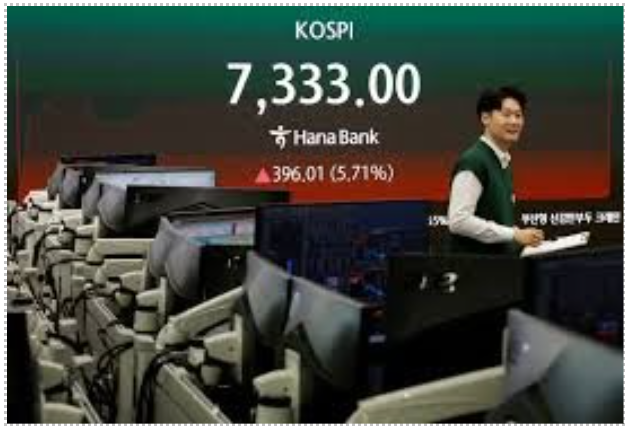
KOSPI at 7,000: A Historic Breakout
South Korea’s stock market recently crossed a level that grabbed global attention. The KOSPI moved past 7,000, marking one of the biggest moments in the country’s market history. But this wasn’t just another index milestone. The rally tells a bigger story about how artificial intelligence is changing the way investors look at markets. Over the last few years, AI has gone from being a futuristic idea to one of the most important themes in the financial world. Investors are now pouring money into companies that are connected to AI infrastructure, especially semiconductor businesses. Since South Korea is home to some of the world’s largest chipmakers, the country naturally became one of the biggest beneficiaries of this trend.

Stock markets often move based on future expectations rather than present conditions. Investors are not simply buying companies because they are doing well today. They are buying because they believe those companies could dominate tomorrow’s economy. That belief is exactly what pushed the KOSPI higher. This situation is similar to what happened in the United States during the internet boom. Back then, internet companies became the face of market growth. Today, AI companies and chip manufacturers are playing that role. Every decade seems to have one defining theme that attracts the majority of investor attention, and right now, AI is clearly that theme.

AI Boom and Semiconductor Rally
The biggest reason behind this rally is simple: AI needs a tremendous amount of computing power to function, and that power comes from chips. Whether it is a data center running in the background or a generative AI tool you use daily, none of it works without semiconductors doing the heavy lifting.
South Korean companies happen to make some of the most important chips and memory components in the world. So when AI spending started picking up globally, investors saw the obvious connection. These Korean firms were going to get a lot busier, and a lot more valuable. Money started flowing in, and share prices climbed.
This kind of market movement has a term: a thematic rally. It basically means investors have latched onto one big idea and are betting on every company tied to it. Here, the big idea was AI, and chip companies ended up being the main beneficiaries. The tricky thing about these rallies is that stock prices can shoot up fast. Investors are no longer looking at what a company earned last year. They are looking at what it could become. An ordinary manufacturing company can suddenly be treated like a booming tech giant overnight.
That is precisely what happened here. These chip companies did not suddenly start doing something radically different. But the way the world sees them changed. They went from being seen as industrial suppliers to being seen as the backbone of the AI era. It also goes to show how fast market moods can turn. A sector that was once seen as unpredictable and cyclical became one of the hottest investment themes around, purely because AI put it in the spotlight.

Samsung’s Rise to the $1 Trillion Club
One of the biggest moments from the rally was Samsung Electronics crossing into the trillion dollar market valuation club. Getting to that number is not just a milestone you put on a trophy shelf. It tells you something real about how much faith investors have placed in where the company is headed.
Market capitalization is calculated using a simple formula:
Market Capitalization=Share Price×Total Outstanding Shares
When a company hits a trillion dollar valuation, it simply means a huge number of people looked at it and said "yes, we believe in this." They put real money behind that belief, expecting the company to keep doing well, keep making profits, and not lose its edge anytime soon. For Samsung, a big chunk of that confidence comes from its position in the chip industry and how well placed it is to ride the AI wave. There is another piece to this story worth understanding: index weightage. Think of it this way. A stock market index works a lot like a group project grade. If the strongest member of the group does really well, the overall score goes up for everyone. Samsung is essentially that strongest member in the KOSPI, which is South Korea's main stock index. So when Samsung has a big day, the entire index tends to ride that wave upward with it. This is not unique to South Korea. In the United States, companies like NVIDIA and Microsoft are so large that their daily price movements can sway the entire market. Samsung is now playing that same role in the Korean market. The trillion dollar moment also says something broader about how investors think. When a company looks like it will be at the center of a major technological shift, people are willing to pay a premium for it. They are not just buying what the company is worth today. They are buying into what they think it will become.

How AI Moved the Entire Market
The KOSPI rally really comes down to one thing: AI needs an enormous amount of computing power to run, and South Korean companies happen to make the chips and memory that provide exactly that. Once investors connected those dots, money started rushing into semiconductor stocks. Samsung rode that wave all the way to a trillion dollar valuation, and the broader index climbed along with it. This is what markets call a thematic rally. A big idea takes hold, people start betting on every company tied to it, and prices go up fast. Funds, hedge funds, and regular investors all wanted a piece of it. The more prices rose, the more people wanted in, and that kept the cycle going.
But here is the thing. Most of that excitement was concentrated around a small group of companies. Plenty of smaller stocks barely moved at all. So while the index looked impressive from the outside, a lot of the strength was sitting in just a few big names. That is not necessarily a bad thing, but it does mean the rally was narrower than it appeared. How long it lasts really comes down to one question: do investors keep believing that AI will continue pushing demand for chips higher and higher.
Valuations, FOMO, and Bubble Risks
All this excitement around AI has also made a lot of people nervous. When everyone rushes into the same trade at the same time, things can get a little frothy. A big part of what is fuelling the buying is plain old FOMO. Prices are going up, people do not want to be left behind, and so they keep buying even when the valuations start looking a bit stretched. It is not the first time markets have been here either. Back during the dot-com era, investors threw money at anything with a website because they believed the internet would change everything. They were right about the internet, but a lot of those stock prices had run way ahead of what the businesses were actually worth.
The AI rally has a similar feel to it, though it is not a carbon copy. A lot of today's chip companies are genuinely profitable and financially solid, which was not always the case with dot-com era darlings. But that does not mean the risks have disappeared. If AI growth slows down or these companies start missing their earnings targets, prices could fall back pretty sharply. Stock prices cannot keep climbing forever on belief alone. At some point the actual business results have to catch up, and that is what separates a real long term opportunity from pure hype.

Lessons for Indian Investors
The KOSPI rally has a few lessons buried in it that are worth paying attention to, especially if you follow Indian markets. For starters, what happens on the other side of the world is no longer someone else's problem. A technology shift in one country can move stock markets globally, and investors who only watch domestic news will keep getting caught off guard. The people who made real money from this rally were the ones who spotted the AI trend early and understood which companies would benefit most. That kind of forward thinking tends to matter a lot more than reacting to whatever the market did yesterday.
At the same time, putting all your eggs in one basket always carries risk. Thematic rallies can be very rewarding but they can also unravel quickly when sentiment shifts. The broader point though is that innovation attracts money, and countries that lead in technology tend to draw the most investor attention. As India builds out its own AI and semiconductor space, similar opportunities could start showing up closer to home. The KOSPI crossing 7000 is ultimately bigger than just a South Korea story. It shows that AI has quietly become one of the most powerful forces driving global markets today, and that is something every investor, wherever they are, needs to be paying attention to in the years ahead.


Comments